High-frequency (HF) induction welding has been the standard way to close the seam on an ERW tube mill for decades. Laser welding does the same job with a different heat source, and the difference shows up in three places: the weld itself, the material you can run, and the equipment around the weld station.
What actually changes at the weld
HF welding induces current in the strip edges and relies on the skin effect and the proximity effect to concentrate that current at the seam. The edges come to welding temperature over a relatively wide band, and the strip is then squeezed together by the squeeze rolls. The result is a solid weld with a relatively wide heat-affected zone.
Laser welding puts a focused beam on the closed seam. The heat goes into a narrow band, so the heat-affected zone is small and the weld bead is narrow.
That single difference is what drives everything else.
What a laser tube mill looks like in practice
Here is a real 60-type laser welded pipe mill specification, so you can see what the equipment list actually contains:
Item | Specification |
|---|---|
Mill type | 60 |
Round pipe | 32–96 mm |
Square pipe | 25×25 mm to 75×75 mm |
Rectangular tube | 100×50 mm |
Wall thickness | 0.8–2.5 mm |
Laser welder | 6000 W, welds up to 2.5 mm, 2 vertical rolls, 40 mm shafts |
Forming section | 8 horizontal + 8 vertical stands |
Sizing section | 4 horizontal + 4 vertical stands |
Shaft diameter | horizontal 60 mm, vertical 40 mm |
Main drive | 2 × 18.5 kW |
Cutter | Automatic circular saw, model 400 |
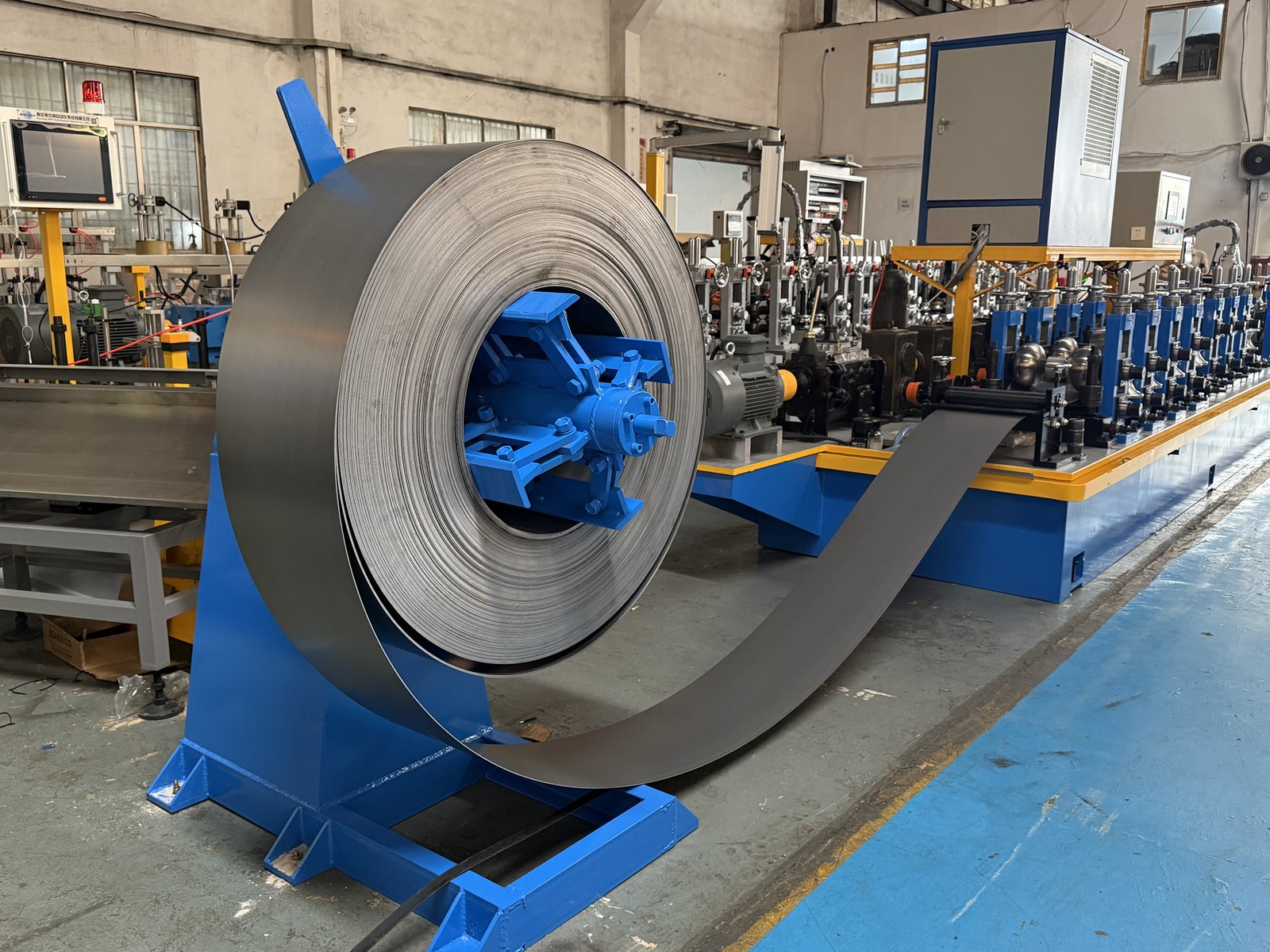
Decoiler | Single-head 5 t manual |
Zinc replenishing unit | 18.5 kW |
Cooling system | 1 set |
Discharge table | 1 set |
Two items on that list do not appear on an HF mill of the same size.
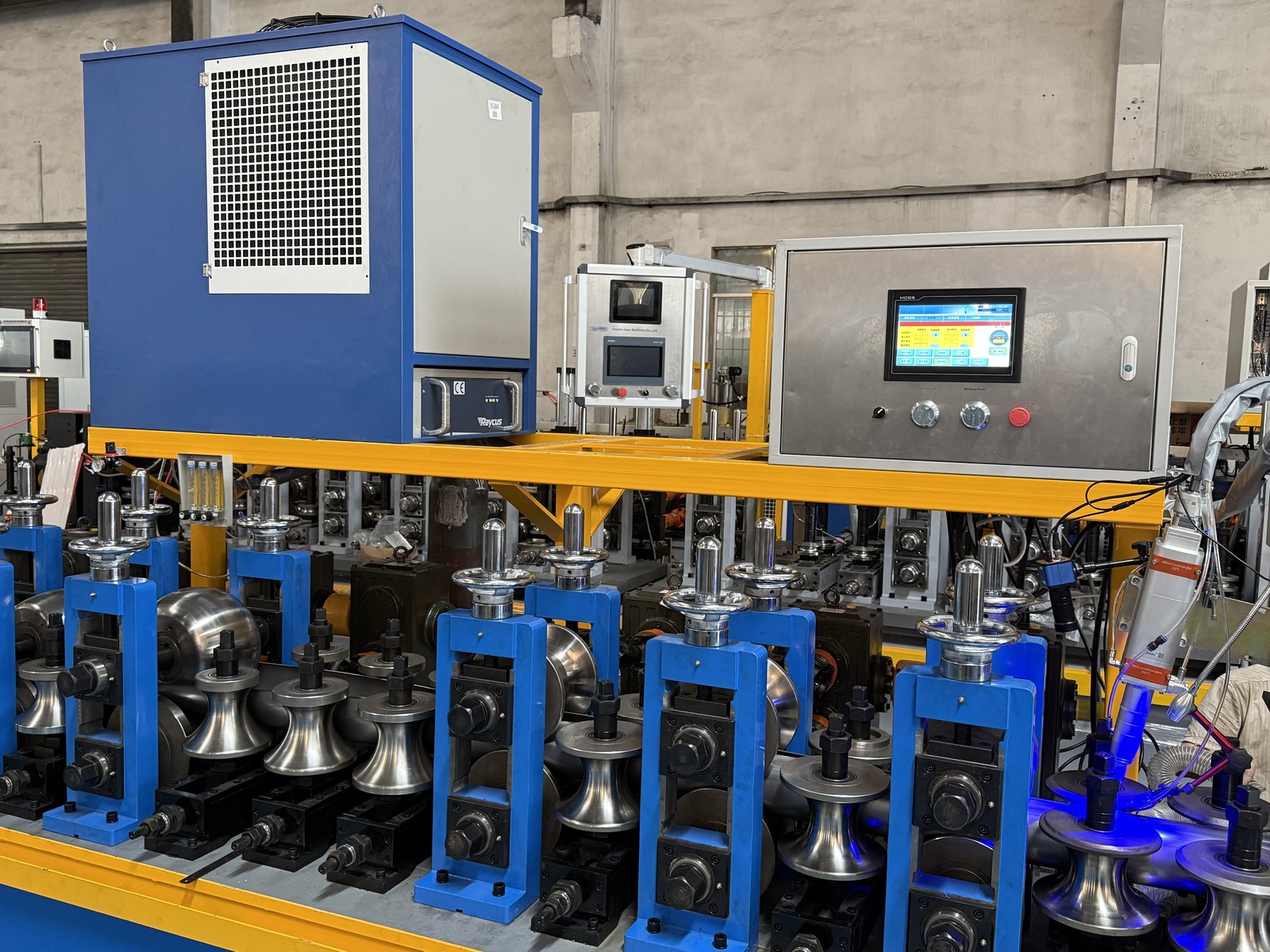
The cooling system. A laser head has to be cooled continuously. It is not an optional extra.
The zinc replenishing unit. This is the tell. A zinc replenishing unit re-coats the weld zone after welding, which only makes sense if the strip is galvanized. When you weld galvanized strip with a wide heat source, you burn the zinc off a band either side of the seam. That band will rust, and on a coated product it also shows. A narrow laser weld burns off less, and the replenishing unit puts the zinc back.
When laser wins
- Thin wall. The specification above covers 0.8–2.5 mm. Thin wall is where a
wide heat-affected zone causes the most distortion.
- Galvanized and coated strip. Less coating is destroyed, and the zinc
replenishing unit restores what was lost.
- Visible welds. If the tube will be powder coated, anodised, or left as-formed
without a scarfing operation, a narrow bead is an advantage.
- Tube near the small end of the range. At 32 mm round tube the weld zone is a
large fraction of the circumference; a narrow weld helps.
When high-frequency still wins
- Thick wall and large diameter. HF equipment scales to heavy wall and big
diameter more cheaply than laser power does.
- Maximum line speed on plain carbon tube. If the product is plain round tube
for structural use and the weld is going to be scarfed anyway, HF is the cost-effective answer.
- Uncoated black tube. There is no coating to protect, so the main laser
advantage does not apply.
The honest answer is that neither process replaces the other. They cover different parts of the product range.
What else changes on the line
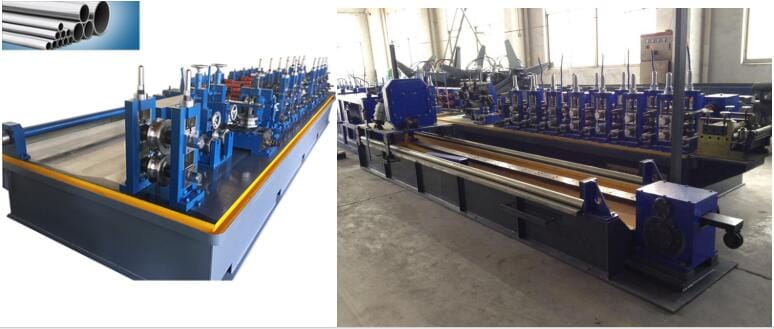
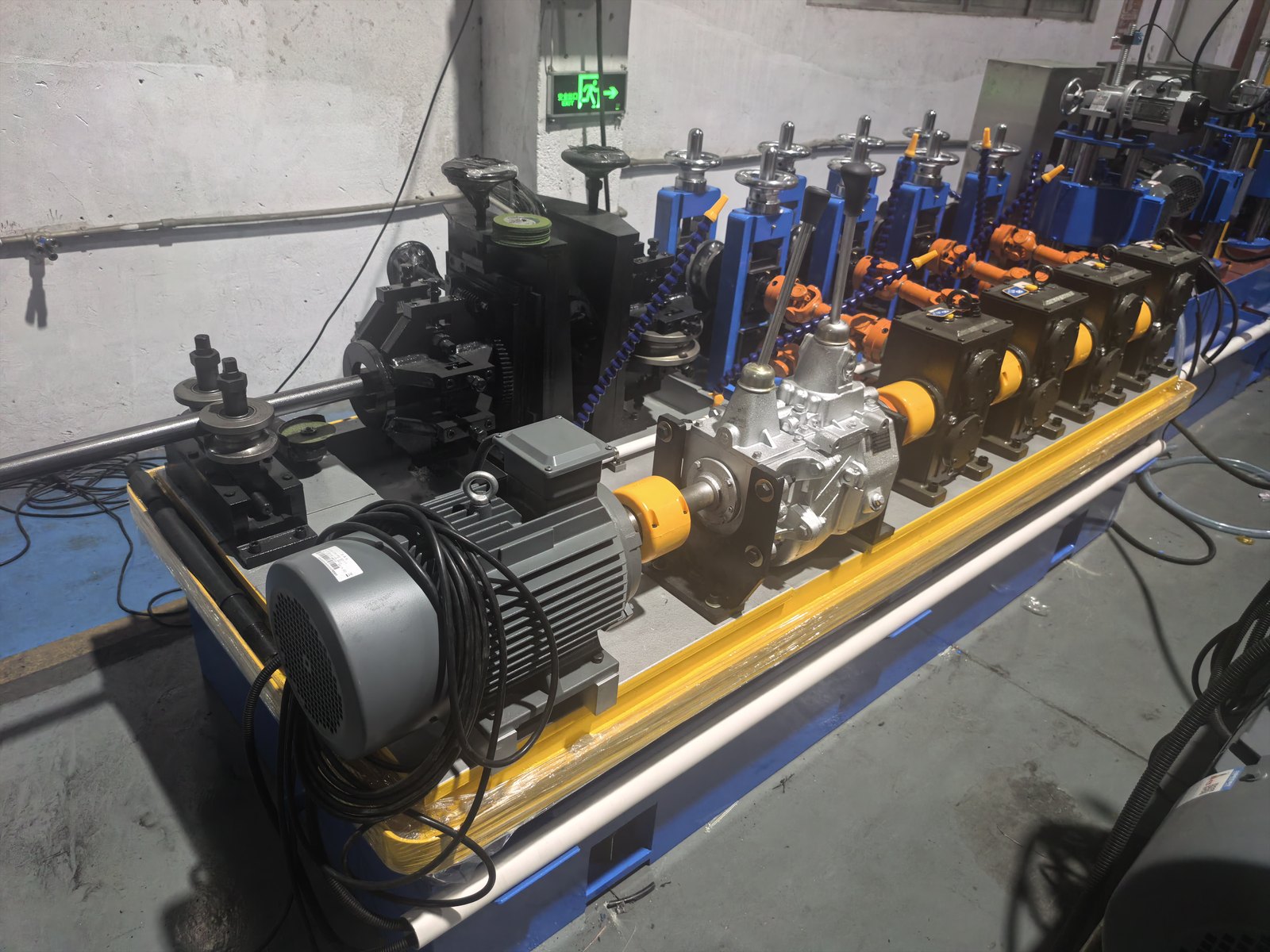
The forming and sizing sections look familiar. On the 60 mill above, forming is 8 horizontal plus 8 vertical stands and sizing is 4 horizontal plus 4 vertical stands, with 60 mm horizontal and 40 mm vertical shafts, driven by two 18.5 kW motors through a gearbox and universal drive shafts.
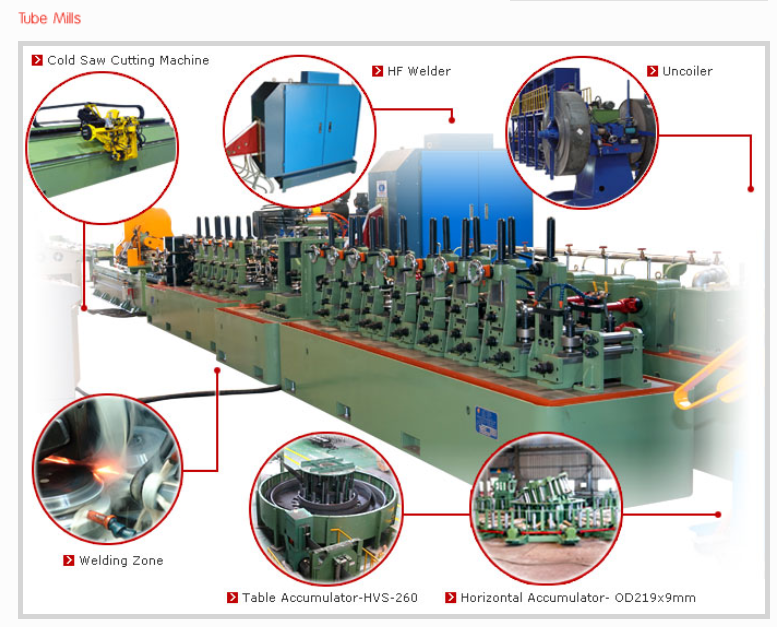
The sequence runs: uncoil → form the flat strip into a round tube → close the seam → weld with the laser head → cool the weld → re-coat the weld zone where galvanized → size to final dimensions → cut to length with the automatic circular saw on the run-out side.
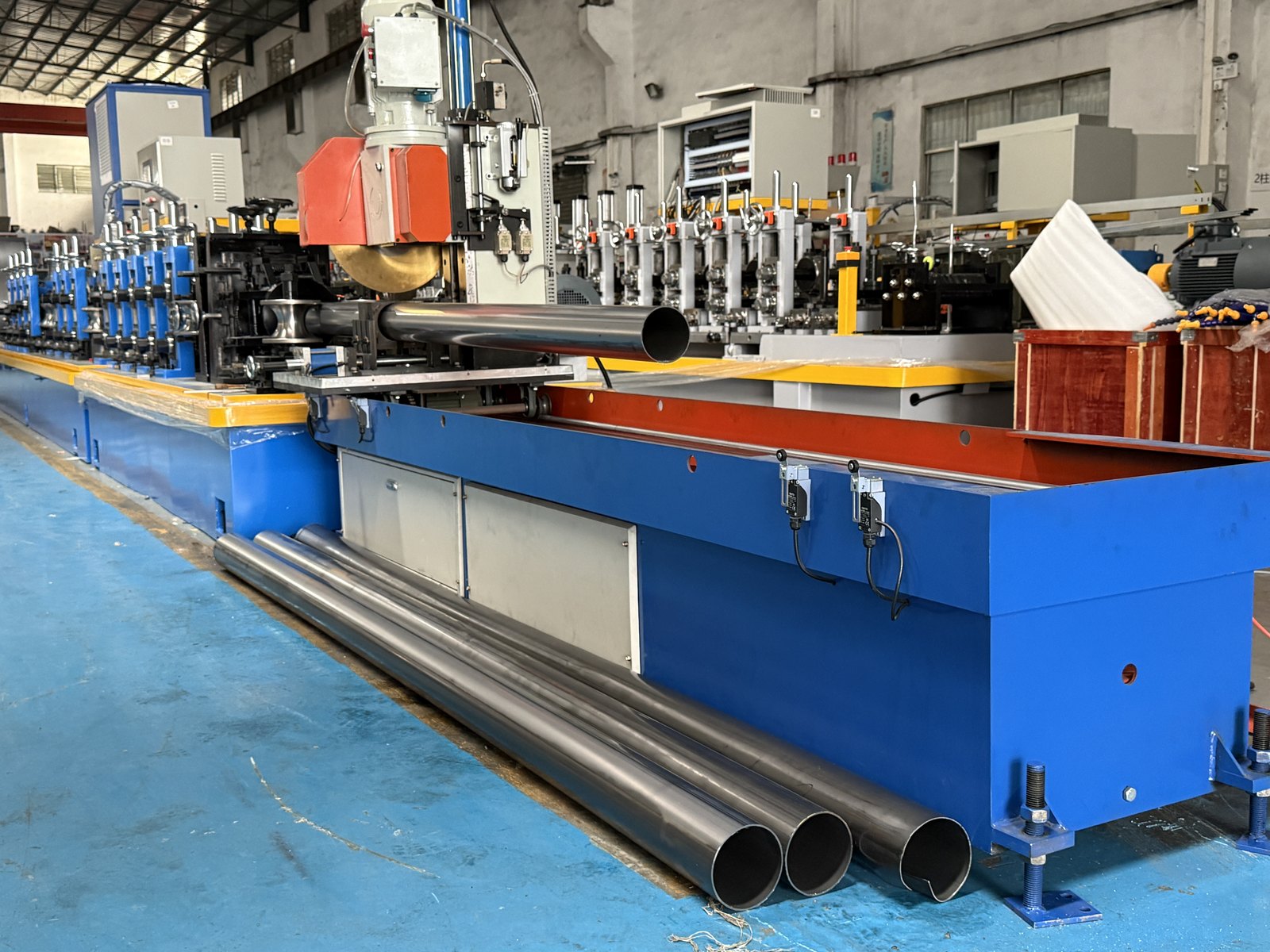
Tooling is quoted per tube size. A typical set covers round 38 mm and 75 mm, square 25×25, 50×50 and 75×75 mm, and rectangular 100×50 mm. Other sizes in your schedule are made to order.
Practical points when specifying
- State the material and grade. The strip grade affects forming behaviour and
weld parameters. A high-strength structural grade behaves differently from a mild drawing grade.
- State wall thickness as a range, not a single value. The mill has to run the
whole range, not the midpoint.
- State the country and voltage. The mill above is built for 415 V, 50 Hz,
three-phase — but 220 V, 60 Hz, three-phase is equally common, and the machine has to be built for the destination.
- Say what language you want on the HMI. Chinese and English is a common
combination, and other languages can be supplied.
- Ask about the zinc replenishing unit explicitly if you are running
galvanized strip. It should be a line item, not an assumption.
Frequently asked questions
Can a laser tube mill weld 3 mm wall? The 6000 W head in the specification above welds up to 2.5 mm. Thicker wall needs more laser power, and above a certain thickness HF becomes the more economical route.
Does laser welding work on galvanized strip? Yes, and it is one of the better reasons to choose laser, because the narrow weld destroys less coating. But the weld zone still needs to be re-coated, which is what the zinc replenishing unit does.
Is a laser tube mill slower than an HF mill? Weld speed is not the only speed in the line. Forming, sizing and cutting set the pace as well, and a laser line can run a normal production rate on thin-wall product while giving a better weld.
What is the 60 in "60-type tube mill"? It refers to the mill size class, and in practice it brackets the tube range you can run — 32–96 mm round in the specification above.
Do I need a different decoiler for a laser line? No. The specification above uses a single-head 5 t manual decoiler, the same class you would put on an HF mill of this size.
*We build laser welded pipe mills and high-frequency ERW tube mills. Tell us the tube sizes and wall thicknesses you need, the strip material and grade, coil weight and inner diameter, your country and supply voltage, and the operating language you prefer — and we will confirm which process suits your product range.*
The laser welded pipe mill
How that comparison is built in practice: laser welded pipe mill, including the tube range it covers and the units the line is made of.
Related pages: Maintenance of High Frequency Welded Pipe Machine, What Gets Checked Before a Tube Mill Leaves the Factory, what is High Frequency Welding Pipe Machine? and Zhongtuo Signs Ordering Agreement with Kazakhstan Customer.