Buying a welded tube mill usually starts in the wrong place: with a model number. The model number is an output, not an input. What actually decides the machine is the tube you intend to sell, and five things follow from it — diameter band, wall thickness, line speed and welder, cut-off, and coil handling. This page walks through them in the order they constrain each other.
Everything below refers to machines whose published ranges are on this site, so the numbers can be checked rather than taken on trust.
Start from the tube, not the machine
Write down six things before talking to any supplier: outside diameter, wall thickness, round or square or rectangular, cut length, monthly tonnage, and the material. If any of those is still "we will decide later", the quotation will be a range rather than a machine, and the range will be the supplier's, not yours.
The reason is that the forming section is built for a diameter band. Running outside that band is a roll-load question, not a setting — you cannot dial a 32 mm mill up to 168 mm, and a 76 mm mill will not run 10 mm strip comfortably. The bands published on this site run from 10 mm to 168 mm across the HG series.
Diameter: the smallest size decides, not the largest
This is the counter-intuitive part. A buyer looks at the largest pipe on the brochure and buys for that. In practice it is the smallest diameter you must run every week that settles the choice, because a mill sized for large tube struggles with small strip: the rolls are too big relative to the section, and the seam is harder to keep closed.
Where the product range straddles two models, the usual answer is the wider machine run slower on the small sizes — cheaper than two lines, unless the small sizes are high volume. The HG series comparison sheet in our downloads section puts the five bands side by side for exactly this decision.
Wall thickness is a roll-load question
Every mill is published with a wall range, and that range is what the forming section and the welder are built for. Heavier wall than published is not a setting — it is more roll load, more welder power and a different squeeze force. If your product mix includes a heavy wall, say so at the start; it changes the machine, not the recipe.
Speed and the welder are one decision
Line speed looks like a headline number and is really a consequence. Published line speeds on this site run 30–90 m/min for the carbon steel HG lines and 3–7 m/min for the stainless units — that gap is not marketing, it is what the material allows. The HF welder is sized with the line: 200 kW on the HG32 and HG76 lines, GGP 400 kW on the HG165 big-diameter line.
So the question to ask is not "what is the maximum speed" but "what speed will this line hold at my wall, with a seam I can sell". A number quoted at thin wall does not transfer to heavy wall.
The cut-off usually sets the cycle
Buyers spend the budget on the forming section and then discover the saw. A flying saw has to accelerate to tube speed, cut, and return before the next length arrives — so at short cut lengths the return time, not the forming speed, caps the line. The published figure for the ZF series is a cut length held to ±2 mm by servo tracing; ask for the cut-to-cut time at your shortest length, not just the maximum line speed.
Coil handling decides what a shift actually costs
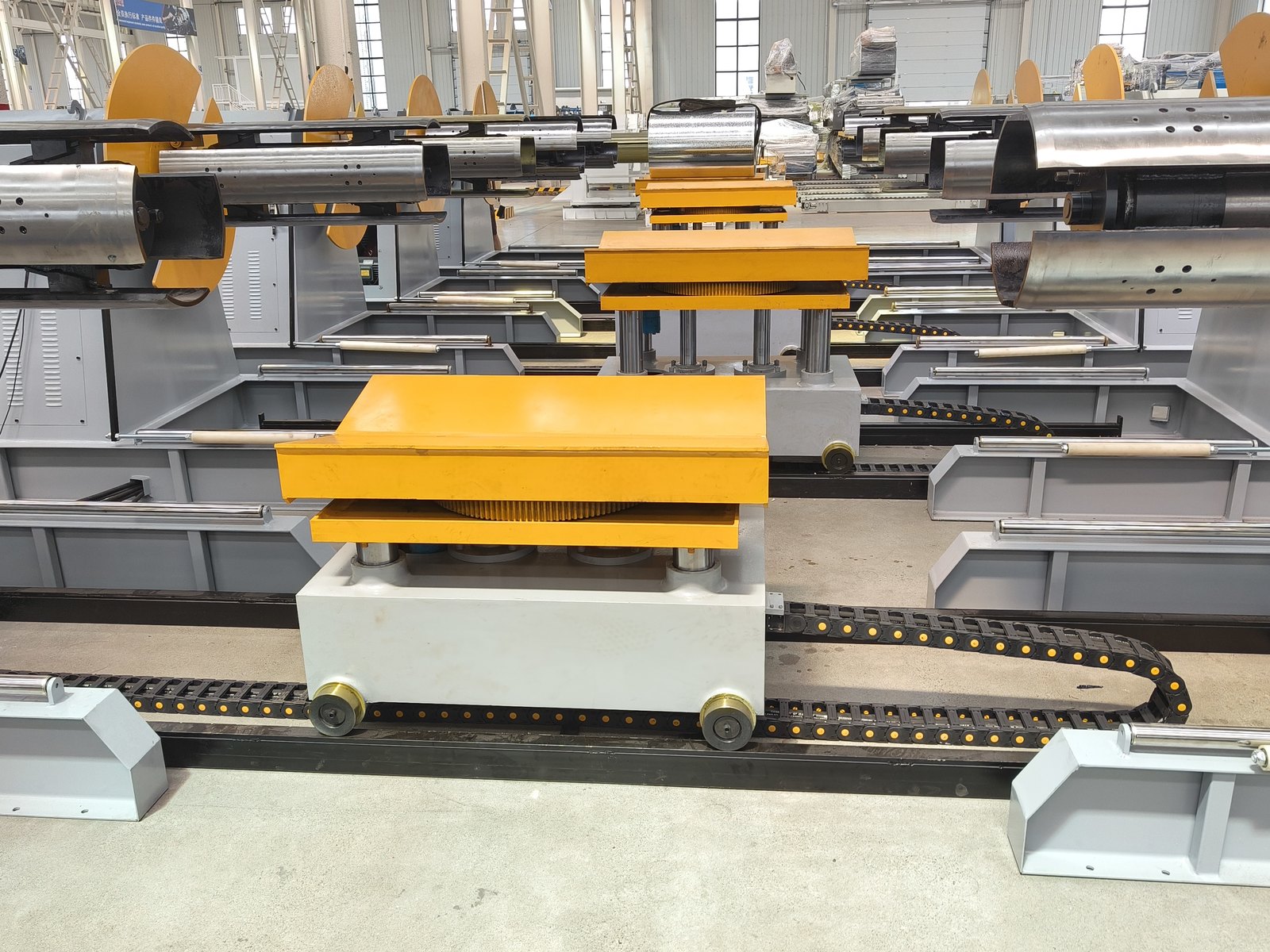
A decoiler that needs a crane and fifteen minutes per coil change costs more per shift than a slightly slower mill. Coil weight and loading method are the numbers to settle first: the lines on this site are published around 7 t coils with hydraulic expansion and a loading car, which is a different purchase from a light mandrel decoiler.
Strip condition matters too. Published strip thickness across the range is 0.3–4.0 mm; if your incoming coil is slit from wider stock, the slitting line becomes part of the decision — widths up to 1600 mm are published, and the strip layout decides your yield more than the machine speed does.
Square, rectangular and special sections
Square and rectangular sections are made on the same mill with a different roll set, and the published maximum for a square section is lower than the maximum round diameter. If your mix is mostly square, specify from the square size, not the round size. Oval, D-section and other profiles are a roll-design question — send the drawing.
What to put in the enquiry
Tube outside diameter (minimum and maximum), wall thickness range, section shape, cut length, material, required output per shift, coil weight and strip width you can buy, supply voltage and destination port. With those eight lines a supplier can quote a machine; without them, only a range.
Where to go next
Browse by machine group: steel pipe machinery, HF pipe welding machines, stainless steel tube mills, coil processing lines, pipe tapering and end forming, tube mill auxiliary equipment
One-page PDFs, including the HG series comparison and the HF welding defect table: datasheets and downloads
Frequently asked questions
How do I choose between two tube mill models?
By the diameter band first — specifically by the smallest diameter you must run every week, not the largest. Then by wall range, because the forming section and welder are built for a published wall. Where the range straddles two models, the wider machine run slower on small sizes is usually cheaper than two lines.
Why are stainless tube lines so much slower?
Stainless strip work-hardens as it is formed and carries heat away from the weld differently, so forming loads and welding energy have to be managed rather than pushed. The stainless units on this site are published at 3–7 m/min against 30–90 m/min for the carbon steel HG lines.
What limits a tube mill's output at short cut lengths?
The cut-off, not the forming section. A flying saw must reach tube speed, cut and return before the next length arrives, so return time caps the cycle. Ask for cut-to-cut time at your shortest length.
Related guide: coil processing — slitting or cut-to-length?