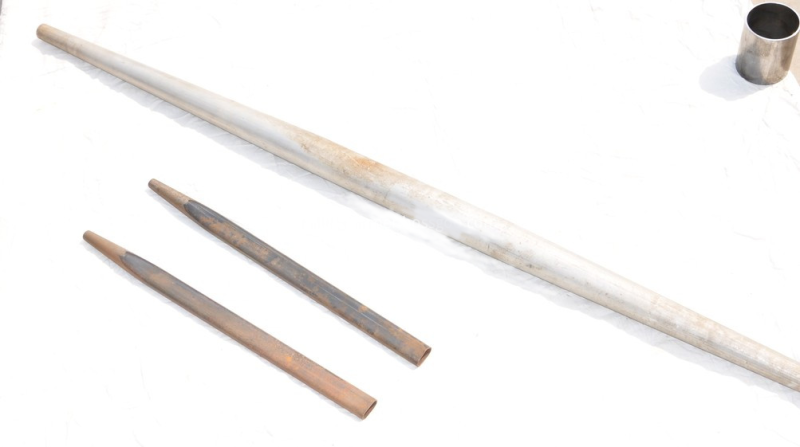
A pipe tapering machine — also listed as a taper pipe end cone former or taper tube end forming machine — forms a cone or taper on the end of a steel tube. It is the operation that turns a plain cut tube into a part that will plug into a socket, weld down to a smaller line, or finish with a closed end.
With different tooling the same hydraulic head also reduces tube diameter and embosses the end, so taper forming, reducing and closing usually come from one machine rather than three.


How the taper is formed
The tube is clamped in the head stock chuck and the forming head — carried on the main shaft — feeds into the end. Tooling shaped to the finished cone spins and presses the wall into the taper, so the profile comes from the tool, not from a programmed path. The head travels on linear slide rails rather than a swing arm, which keeps the propulsion straight and makes the taper repeat from part to part.
Control is by microcomputer with hydraulic drive. Automatic cycling and manual jog are both available, which matters when a new cone has to be set up before a batch runs.

Specifications — ZSG50NCB
Parameter | ZSG50NCB |
|---|---|
Max tube capacity | 50 x 2 mm (tube OD x wall) |
Max forming length | 300 mm |
Processing speed | 7-30 s per end |
Motor power | 4 kW |
Dimensions | 2770 x 900 x 1350 mm |
Weight | 2125 kg |
The figures above are as published for the ZSG50NCB. Cone angle, tooling size, supply voltage and anything not listed in the table are confirmed at quotation — they depend on the finished end rather than on the machine.
Model 50 and Model 60
Model | Max tube capacity | Max forming length | Motor power |
|---|---|---|---|
Model 50 | 50 x 2 mm | 280 mm | 5.5 kW |
Model 60 | 60 x 2 mm | 350 mm | 7.5 kW |
This page publishes two naming schemes, ZSG50NCB and Model 50 / Model 60. Both are listed here exactly as published; confirm which scheme applies to your order when you ask for a quotation.
Materials and control
Suitable materials are carbon steel, stainless steel, aluminium, alloy steel, copper and brass. Control is by microcomputer with hydraulic drive, with automatic and manual operation available. The HMI is supplied in English or Chinese, and other languages can be prepared on request.


What to send with an enquiry
1) Tube outside diameter and wall thickness.
2) The finished end: cone angle and taper length, or the diameter you want to reduce to, or whether the end is to be closed.
3) Material, and how many ends per shift you need to form — that decides between a single-station head and a second station.
FAQ
What does a pipe tapering machine do?
It forms the end cone and taper on a tube end. With different tooling the same machine is used for tube reducing and for end embossing, so tapered ends, reduced ends and closed ends come off one head.
What materials can the taper forming machine work?
Carbon steel, stainless steel, aluminium, alloy steel, copper and brass.
What is the largest tube the ZSG50NCB handles?
The ZSG50NCB is published for tube up to 50 x 2 mm, with a maximum forming length of 300 mm and a 7-30 s processing cycle. The larger model is published at 60 x 2 mm with a 350 mm forming length.
Related pages: pipe tapering and end forming machines, tube reducer tube end forming machine, tube closing machine pipe end locking machine, C-Types E-Types IO-Types endformer tube end working machine