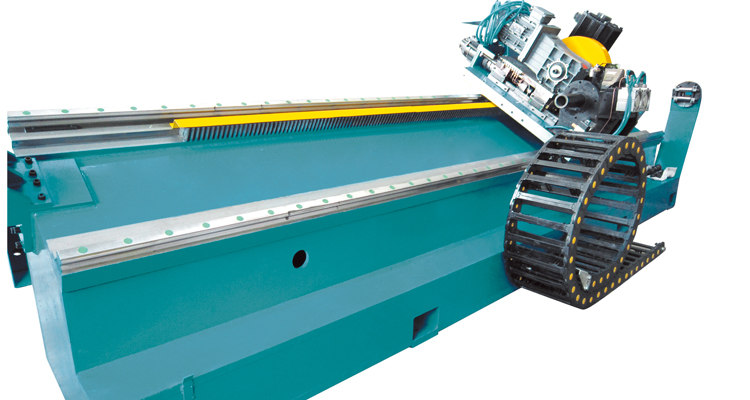
A flying saw cuts the tube to length while the tube is still moving, so a welded pipe mill does not have to stop for every cut. The saw carriage locks onto the tube, travels with it, makes the cut and returns, then waits for the next length.
On the lines published on this site the ZF series is a cold-cutting saw: the cut is made in chip mode rather than by friction or plasma, which the machine pages describe as quieter, safer and leaving a smooth end without burrs.
How the cut stays square while the tube moves
The carriage is driven by locomotor control that traces and synchronises with the moving tube, so the saw is travelling at tube speed at the moment the disc enters the wall. The cut is completed by a servo feeding mechanism, which the pages also credit for extending disc life. Length is set from the human-machine interface, and the published tolerance for the fixed length is +/-2 mm.
What the ZF series states
Feature | As published on this site |
|---|---|
Cutting method | Cold cutting in chip mode — described as less noise, higher safety, smooth cut end with no burrs |
Tracing | Locomotor control traces and synchronises with the moving tube to hold cutting precision |
Feeding | Servo feeding mechanism completes the cut and is credited with extending disc life |
Cut length | Servo tracing holds the fixed length to +/-2 mm |
Control | Human-machine interface so parameters can be changed quickly |
These are the statements published for the ZF series. Throughput, disc diameter for a particular model and the motor rating are set by the line the saw is built into — see the table below, where the figures come from the line pages that publish them.
Saw disc and drive, as published with the lines
Line that lists the saw | Saw disc | Saw drive |
|---|---|---|
HG76 strengthened tube mill | OD400 x ID40 x 2.8 mm | not published on that page |
High-quality tube machine line (large diameter) | OD800 x ID110 x 6.0 mm | AC 45 kW |
HG165 big diameter tube mill | not published on that page | AC 90 kW |
Saw carriage travel on the large-diameter line is published as rack and pinion with gear lath, and the saw waver as pneumatic. Where a cell says "not published", that value is confirmed with the line specification at quotation rather than guessed here.
Where the saw sits in the line
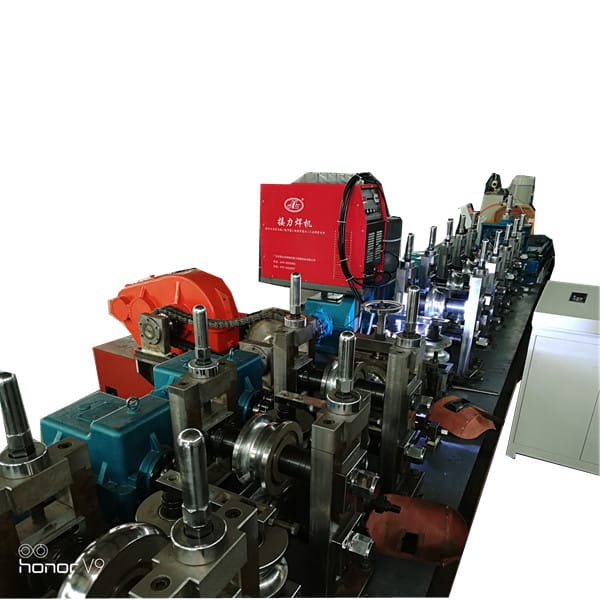
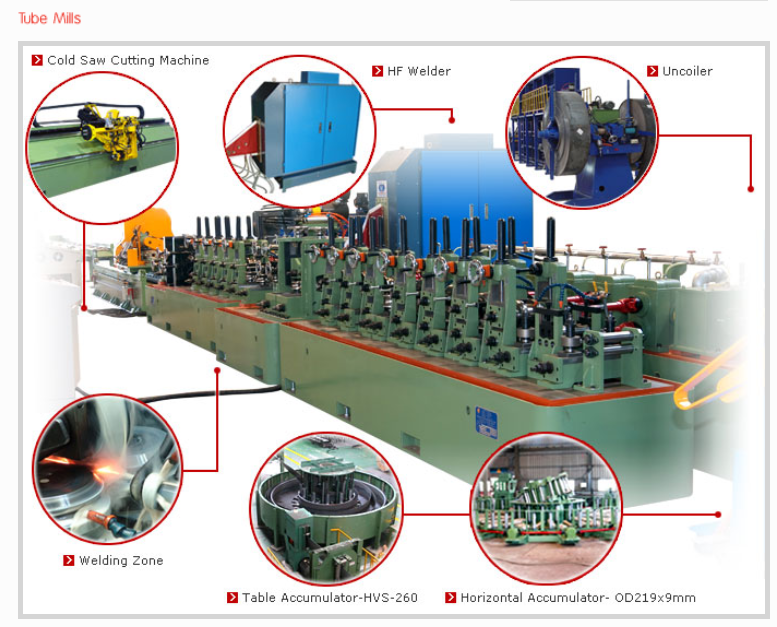
In the equipment lists published on this site the flying saw sits after sizing and straightening and before run-out: the tube arrives at final size, is cut to length on the move, and the finished length drops onto the run-out table. Lines on this site that list a flying saw include the ZT-32 straight seam pipe-making line, the ZT-76 straight seam pipe-making line and the HG76 carbon steel tube mill.
What to send with an enquiry
1) Tube outside diameter and wall thickness, and the maximum cut length you need.
2) Line speed, so the saw carriage travel and the return time can be matched to the mill.
3) Whether the cut end is welded, threaded or expanded afterwards — a burr-free cold cut matters more for some of those than others.
Frequently asked questions
What does a flying saw do in a pipe line?
It cuts the tube to length while the tube is still moving, so the mill does not stop for every cut. In the equipment lists on this site it sits after sizing and straightening and before the run-out table.
How accurate is the cut length?
The page states that servo tracing holds the fixed length to +/-2 mm.
Is the ZF series a cold-cutting saw?
Yes. The page describes it as cold cutting, where the cut is made in chip mode, and states that this gives less noise, higher safety and a smooth cut end with no burrs.
Related pages: tube mill auxiliary equipment, HF pipe welding machines, HG76 tube mill, welded pipe mould rollers